Loading
Loading
Các chương trình Tiến sĩ (PhD) của chúng tôi mang đến cơ hội học tập nâng cao với sự linh hoạt khi hoàn thành các học phần trực tuyến trong một chương trình bậc tiến sĩ.
The tourism and hospitality industry are a fast-growing, dynamic, and global industry with a variety of career options for individuals to develop into upper-level managerial positions. The Associate Degree coursework…

The tourism and hospitality industry are a fast-growing, dynamic, and global industry with a variety of career options for individuals to develop into upper-level managerial positions. The Associate Degree coursework will allow students to gain a comprehensive managerial knowledge base of the processes and strategies used by leading firms to gain a competitive advantage in the tourism and hospitality industry. The content of the courses centrally focuses on developing the student’s hospitality operational, Chef and Waitress skills.
This course prepares you to work in the global force. The hospitality industry employs more professionals than almost any other. In the US, the industry lands among the top three employers each year. Within the field, there is a staggering array of different jobs and a wide variety of work settings that employ people at resorts, restaurants, hotels, casinos, and essentially anywhere that people dine and lodge. Cooks and chefs also find work in a food service sector that is more institutional in nature and includes jobs at hospitals, schools, corporate facilities and municipal cafeterias.
Waiter training courses will not only teach you how to be a good waiter! Just being a waiter or a waitress is not enough! You want a career in the best restaurants in the world, you want to make great money and live an amazing life. That is what this is all about!
The hospitality industry employs more professionals than almost any other.
You will learn how to get a new job, how to win a job interview, and grow in the Hospitality Industry. Those courses will give you the wine knowledge, the food knowledge, and the skills to be the best waiter in the world as selling and up-selling in the restaurant, how to handle the guest’s complaints, or how to deal with rude guests.
This program also offers a specialization component for a total of 69 credits to completing this degree. This specialization aspect of the program is specifically designed for those that are interested in working in the Cruise Ship Industry (see details below).
Course Duration: 18 months
12 Weeks Course Per Semester
A minimum of 3 credits per semester
A thesis paper is required to be written at the end of the program
Books are not included in the program cost. Books can be
ordered on Amazon
All classes will take place online via Zoom
Total Fee: $ 31,000.00 (no refunds)
Prerequisites: High school Diploma or
Prior Learning Experience (4 Years on the field) or
Resume indicating prior experience
Courses
RCM 4121 Introduction to Hospitality and Tourism
BHM 4310 Hospitality Marketing
BHM 4412 Strategic Management Applications in the Hospitality Market
DCR 4210 Customer Relationship Management
GSD 4111 Conversational Listening and Speaking
ADW 1012 Waiter and Waitress
ADC 2056 Cooking and Baking
RCM 4121 Introduction to Hospitality and Tourism
Course Description
This course is an introduction to the hospitality and tourism industry. It will cover many components of the industry, providing students with a broad-based understanding. We will be examining the history of the industry as well as the impact that it has on the economy. We will be exploring career opportunities and students will have the opportunity to build the skills essential to managerial success in this industry.
This course explores the world of hospitality and tourism from a business context. As in all businesses, business demand comes from a variety of users, each with their own needs and preferences. Suppliers and vendors from this industry are also unique in the products they provide. Tourism and hospitality businesses are diverse and worldwide. This course explores the business issues of tourism, taking into account the roles of travel agents, the importance of transportation modes, differing accommodation types, destinations and attractions management, and food and beverage operations
Course Objectives
To provide students with detail components of marketing strategy and marketing plan for a hospitality or tourism organization.
To evaluate the strengths and weaknesses of hospitality or tourism organization's marketing strategy and plan.
Course Goals
Upon completion, students should be able to:
- Understand the various segments of the hospitality and tourism industry
- Develop an appreciation for the importance of the hospitality and tourism industry to the economy of cities, states, and nations
- Understand the challenges faced by professionals in hospitality management and learn about current operating procedures in the hospitality and tourism industry.
- Understand the global perspective on industry issues, both present and future in addition to the current knowledge of the functions of management in the hospitality and tourism industry
Course Content
• Introduction to Hospitality and tourism
- The importance of infrastructure
- The importance of service
- The importance of marketing
- The changing world of travel
• Places and people – Destination Geography
- What does the Destination look like
- How does it relate to other destinations
- What is the local customs like
- Where do I find information
• The North American Aviation System
- Evolution of t he aviation systems
- Airline classification
- Rules and regulation
- Airline routes
- Products distribution
- Codes and jargons
- Automation
- The airline reservations
- Domestic airline fares
- The disappearing of airline tickets
- New methods of distribution
• Airports – Gateways to the world
- Evolution of the airport
- Airports design
- Flight operations
- Airport management
- Airplanes
- The passengers air travel process
- Baggage handling
- Special requests
- Aviation safety
• The International Experience
- Rules and regulation for international travel
- Travelers health and safety
- Customs regulations
- Foreign exchange
- International aviation
- Routes ands schedule
- International airline fares
- Reservations and ticketing
- The international air travel experience
- Developing a tourist friendly image
• Travel by Rail
- Evolution of the rail industry
- Domestic passenger trains
- International passenger train
• Travel by Road
- Evolution on the rental car industry
- The cost of business
- International rental
Assessment: Mid Semester Test
• Cruising and Other Waterways
- Evolution of the Cruise industry
- The cruise products
- Tradition of the Sea
- Life aboard ships
- Passenger profile
- Cruise areas
- Ferries
- Freighters
- Rules and regulation
- Management on ship and shove
- Cruise sales
- Cruise reference books
• Travelers at Rest – The Hospitality Industry
- Evolution of the modern Hotel
- Marketing of the hotel property
- Hotel consideration
- Corporate structure
- Hotel stuff
- Food and Beverage
- Hotel Sales
- Rules and regulations
- Reservation
- Hotel reference
• Touring the World
- Evolution of the Tour
- Mass tourism
- Types of tours
- Rules and regulation
- Tour development
- Tour sales and operation
• Meetings and Incentives
- Evolution of the modern meeting
- Meeting development
- Operating the meeting
- Rules and regulation
- Incentive development
• Providing Service and Sales
- The dimensions of Marketing
- Evolutions of the travel agency
- Rules and regulation
- Corporate travel
- The all-purpose agency
- Risk management
• Course Review
Assessment: Final Examination
Prerequisites: BHM 4121 Human resources in Hospitality
Industry
Recommended Text: Viewpoint: An Introduction to Travel, Tourism, and Hospitality, by Nona Starr Prentice Hall; 4 editions (June 13, 2002), ISBN: 0130987875
Hospitality World! : An Introduction (Hospitality, Travel & Tourism), by Harold E. Lane, Denise Dupre Wiley (September 13, 1996), ISBN: 0471289892
Introduction to Hospitality (4th Edition), by John R. Walker, Prentice Hall; 4 editions (January 13, 2005), ISBN: 0131191012
BHM 4310 Hospitality Marketing
Course Description
This course focuses on hospitality marketing as an integral part of operations, with an overview of hospitality marketing, products, and services, through the basics of marketing, segmentation, and targeting, as well as branding, distribution, location, pricing, and communication. This course develops strong marketing planning and strategy, including clear step-by-step guidance on developing an effective marketing plan. The course explores areas of marketing responsibility such as human resources, marketing and sales, and advertising.
Course Objectives
This course aims to apply the general principles of marketing to the hospitality and tourism industries, comparing and contrasting the specifics of each field. The study provides a foundation for those specializing in the marketing of these services. Marketing mix, consumer behavior, targeting and positioning are covered in depth. Pricing, distribution channels, principles of promotion, and product development are addressed as well. The study culminates with an outline for development of a marketing plan, preparing the student for a comprehensively effective role in hospitality marketing management.
Course Goals
At the end of this course, students would be able to:
• Understand the various as marketing management that applied to the hospitality industry
• Understand the use of menu list as a tool of marketing in the hospitality industry and develop success strategic approach to menu marketing
• Develop and distinguish marketing from selling and explain how a marketing plan is developed.
Course Content
• Introduction to Hospitality Marketing: The function of marketing
- Introduction to marketing
- The marketing mix
- The marketing environment
- The marketing management cycle
- Marketing within the organization
○ Introduction to Hospitality services marketing
- Introduction to service marketing
- Service
- Quality
- Customer satisfaction
- Trends affecting the hospitality industry
Understanding the Behavior of Hospitality Consumers
- Factors that influence consumer behavior
- Consumer decision making model
- Consumer problem solving processes
- Consumer problem solving techniques
- Organizational buyer behavior
Marketing segmentation and positioning
- Segmentation variables
- Market segmentation decision
- Market segmentation strategies
- Positioning the products service mix
Developing a marketing plan
- The marketing planning process
- Sales forecasting
Developing New products and services
- Planning for new products
- Organizing for new product planning
- New product development services
- Identifying products and services
Product-service mix strategy
- Product life cycle
- Applying the product life cycle
- Other products concepts
- Managing in the service environment
Intermediaries, and Electronic Commerce
- Distribution management
- Intermediaries
- Electronics commerce
Promotion and Advertising
- Managing the promotional mix
- Advertising management
- Planning and evaluating advertising campaigns
- Effects of advertising
Advertising and Media planning
- Print media
- Broadcast media
- Direct mail
- Support media
Sales Promotion, Merchandising, and public Relations
- Merchandising
- Public Relations
Personal Selling
- Selling to group markets
- The personal selling process
- Personal selling tools
- Ethical issues in personal selling
Pricing Strategy
- Factors that effect pricing decisions
- Pricing techniques and procedures
- Segmented pricing
- Yield management
- Pricing law and ethics
Using Menu Design as a Marketing Tool
- Menu-Planning considerations
- Producing the printed menu
- Other issues surrounding menu planning
- Menu evaluation
Course Review
Assessment: Final Examination
Prerequisites: RCM 4121 Introduction to Catering
Management
Recommended Text: Hospitality Marketing Management, by Robert D. Reid, David C. Bojanic, Wiley; 4 edition (February 25, 2005), ISBN: 0471476544
Human Resources Management for Hospitality, by Mary Tanke ", Thomson Delmar Learning; 2 edition (July 6, 2000), ISBN: 082737321X
Human Resource Management for the Hospitality Industry, by Karen Eich Drum, Wiley (January 1, 1990), ISBN: 0471289728
Marketing for Hospitality and Tourism (3rd Edition), by Philip Kotler, John T. Bowen, James C. Makens, Prentice Hall; 3 edition (July 10, 2002), ISBN: 0130996114
Marketing Hospitality, by Cathy H. C. Hsu, Tom Powers, Wiley; 3 edition (June 22, 2001), ISBN: 0471348856
Hospitality Sales: A Marketing Approach, by Margaret Shaw, Susan V. Morris, Wiley; 1 edition (August 30, 1999), ISBN: 0471296791
BHM 4412 Strategic Management Applications in the Hospitality Market
Course Description
This course focuses on the knowledge and skills of the students to understand develop and apply entrepreneurial, strategic, management and policy principles to the hospitality and tourism industry. The course provides a strategic and entrepreneurial approach to the decision-making process in the hospitality and tourism industry. This course emphasizes the dynamic, often unpredictable and uncertain "Open Systems" nature of the hospitality and tourism business. It stresses to the student that strategic management and entrepreneurship are interdisciplinary, ongoing and creative processes that are conducted at all levels of successful organizations. Students will be able to draw on their knowledge and industry experiences to understand various business challenges using case studies and other strategic analysis.
Course Objectives
To develop students understanding and build credibility even in times of high uncertainty in the hospitality industry
To develop a personal vision, clarify your values, and identify steps needed to develop shared values within the organization
To demonstrate effective leadership in the highly dynamic and often uncertain environment of today’s work force.
To identify the process—and pitfalls— of wide scale organizational change and increase students effectiveness in shaping strategic change
To explain the importance of strategic resilience and develop an action plan to improve personal, group, and organizational resilience
Course Goals
At the end of the course, student would be able to:
• Understand the concepts of strategic management and its application to the hospitality industry
• Describe the co-alignment principle and its application to the hospitality industry
• Appreciate that strategic management is a way of thinking, not a process to be performed annually and then forgotten for a year
• Understand the demand/supply and technology relationships that exist in the service industry and how they affect the strategy
• Understand the unique elements of the service industry and how they affect strategy-making
• Develop an appreciation of the forces driving change in the hospitality industry and what inputs they will have on the manager of the future
Course Content
- An introduction to the Strategic Process
○ Strategy and strategic objectives for travel and tourism industry
○ Introduction to strategy to strategy for travel and tourism
• Internal analysis
○ The travel and tourism organization – competences, resources and competitive advantage
○ The travel and tourism organization – the human context
○ The travel and tourism organization – financial analysis and performance indicators
○ The travel and tourism organization – products and markets
External Analysis
○ The external environment for travel and tourism organization – the macro context
○ The external environment for travel and tourism organization – the micro context
○ SWOT Analysis
Strategic Choices
○ Competitive strategy and strategic direction for travel and tourism organization
○ Strategic methods of development for travel and tourism
○ Strategic evaluation and selection
Strategic Implementation
○ Strategic implementation for travel and tourism organization
○ International and global strategies for travel and tourism organization
○ Strategic management – present and future trends
Case Analysis in Strategic Management
○ Strategic Alliances in the airline industry
○ Holidaybreak Plc: adapting for success
○ Leicester Promotions: destination management for maximizing tourist potential
○ My Travel Plc (formerly Airtours): competing in the travel industry big league
○ Competitive strategy at Ryanair
○ The UK outbound tour operators industry
Course Review
Assessment: Final Examination
Prerequisites: BHM 4224 Hospitality Marketing/ BHM 4414
Service Production and Operation
Management
Recommended Text: Strategic Management for Travel and Tourism, by Nigel Evans, David Campbell, George Stonehouse, Butterworth-Heinemann (January, 2003), ISBN: 0750648546
Strategic Management in the Hospitality Industry, 2nd Edition, by Michael D. Oslen, Eliza Ching-Yick Tse, Joesph J. West, John Wiley & Sons; 2 edition (September 11, 1998), ISBN: 0471292397
Introduction to Management in the Hospitality Industry, by Tom Powers, Clayton W. Barrows Wiley; 7 edition (February 8, 2002), ISBN: 0471359017
DCR 4210 Customer Relationship Management
Course Description
Over the last decade, too many organizations have assumed that their products or services were so superior that customers would automatically keep running and coming back for more. However, in order to compete effectively in today’s marketplace, organizations must change their strategy to become more customer focused, not product focused, and this is the theme and focus of this course.
The customer relationship management is the effective approach and technique to integrate this customer-facing approach throughout an organization. The course, therefore, covers the developing of the market oriented strategy, innovative products and services offered, sales and channel transformation, customer relationships marketing and customer care. The course also explores the use of CRM in an enterprise, as an approach to not only acquire and deploy knowledge about the customer, but also to improve and automate business processes that deliver value to your organization’s customers, suppliers and employees.
Course Objectives
The customer service chain executives are rapidly changing and evolving as managers with a custodial duty and fiduciary responsibility for the information-rich stream of impressions, preferences, and needs of your customers as relationships evolve over time.
Hence, the objective of this course tries to identify and analyze the implications of key shifts in communication technology and the call centers application processes, then proposes strategic and practical perspective towards adapting, transitioning, and exploiting change into more effective ways to improve core business operations.
Course Goals
We expect that at the end of this course, students would have developed effective knowledge and skills in:
• Understanding the CRM concepts and methodologies, and be able to define and formulate strategies for customers, channel and products, and infrastructures for the organization.
• Understanding and being competent to implement and demonstrate how to integrate several CRM technologies at a time for maximum result in the creation of effective customer relationship management.
• Understanding all aspects of CRM, including the development of a market-oriented strategy in respect of innovation in products and services, sales and channels transformation, customer relationship marketing, and customer care.
• Demonstrating how CRM links people, process, and technology to optimize an enterprise's revenue and profits and provide maximum customer satisfaction
Course Contents:
Introduction to Customer Relationship Management.
Definition of the CRM concept.
Putting the CRM to work: the rise of the Relationship.
Electronic application of the CRM concept.
CRM vs. SFA
Market View.
Customer Perspectives and Market Conditions.
Competition.
Customer Profiles
Embracing the changing edge in e.CRM.
Influence of technological environment.
The Digitization of the Customer’s call.
Communication networks in the e.CRM.
Shift in customers needs demands, and expectation.
Internal Information, and Internal Matters: Sales/Distribution
The Decade, Demographics and Devices of Call Centers.
Technological influence on calls centers.
Demographics of the customers.
Changing communication demographics.
The New Call Center Alternatives for the Web Callers.
The Internet and The WWW e.Business.
Operational and Technical Primer for Call Center.
The Role of Internet Telephony and Voice over IP (VoIP).
Operational Implications for Call Center Support Staff.
Implementing and Managing Webmail message processing Support.
• Strategies, Market Opportunities and Goals & Objectives CRM Strategies.
Assessment: Mid Semester Test.
Prerequisites: None.
• Call Centers Meets Webmail and processing the Email.
Web Page email traffic.
Techniques for quick responding to the email traffic and the Text Message Processing.
Technologies for efficient message processing and responsiveness with informational text and Data.
The Automatic Message Distribution.
Voice Messaging within the domain of the Internet and the WWW.
Technical Intimacy and the Art of Customer Loyalty.
The Loyalty effect.
Creating loyalty.
From customer loyalty to customer dependency.
Data Mining impact on …… towards the call Centers.
Marketing.
Relationships marketing.
Customer Intimacy.
Enterprise Relationship Management Applications.
Customer acquisition and CRM.
Application Databases servers to Call Centers.
• The Call Center Humanware.
• Enabling the CRM Strategy.
Implementing CRM.
Usining catalytic measures to improve CRM.
Best practices in outsourcing CRM.
Learning and Knowledge Management.
Implementing the CRM Strategies.
• The Infrastructure Strategy.
Using the Tools.
CRM in the telecommunication Industry.
• E.Business and Customer Relationship Management.
The e.Commerce and the e.Business.
The traditional Customer telephone Interactions.
The Internet Based alternatives.
New Communication technologies on the Internet.
• The Neural Networks and the Customer Services.
• The Need for effective Channel and Product Strategies.
Customer Relationship Management.
Channel Management and Customer Relationship Management.
Embracing the e-channel.
The customer centric.
• The Informal Call Center and The Relationship Communications.
The informal call centers.
Multimedia Communication contact control.
Interaction through back-office database servers.
Unified message/call Management (UM/CM).
Call/message routing technologies.
Redefining Roles, Organizational Change.
Work/Information Flow, and Migration Management.
Course Reviews.
Assessment: Final Examination.
Prerequisites: None.
Recommended Texts: The Executive’s Guide to Customer Relationship Management, by Paul Anderson, Art Rosenberg, Doyle Publishing Company, ISBN 0965335941, 2nd Edition, January 2000.
The Customer Relationship Management Planning Guide V2.0: CRM Steps I & II, Customer-Centric Planning & Redesigning Roles, by Dick Lee, High-Yield Marketing, ISBN 0967375711, May 2000
Recommended Journals: CRM: a three-letter word for service excellence, by Howard Kendall, Founding Director, CSM Group, (formerly Helpdesk User Group), SRN Journal, Volume 2 No 1
Speech recognition: The future of Customer Relationship Management (CRM), by Richard Croen, President and CEO, Nuance, The Journal of Customer Loyalty, Issue 15 Q3 2000.
'Relationship Marketing in Consumer Markets: Antecedents and Consequences', by Sheth, J. N. and Parvatiyar, A. (1995) Journal of the Academy of Marketing Science, Vol. 23, No. 4, pp. 255-271
GSD 4111 Conversational Listening and Speaking
Textbooks:
ESL Beginner: English as a Second Language. (2013) By: Beguchwal, S., Pugni, J., Ramdehell, D. and Robbian, L.C. Research & Education Association ISBN: 13-978-0-1100-6
Student Learning Outcomes:
1. Perform low-intermediate speech acts for everyday communication such as greetings, introductions, leave taking, invitations, requests, telephone routines, and expressions of thanks.
2. Use basic conversation management skills such as initiating conversations, turn-taking, interrupting, asking for clarification, and indicating lack of understanding.
3. Use comprehensible pronunciation and correctly produce inflectional endings for verbs, nouns, adjectives, simple sentences, compound sentences, and modifiers.
4. Demonstrate understanding of spoken English by identifying main ideas, setting, purpose and relationships between speakers in low-intermediate level conversations and narratives dealing with everyday situations.
5. Utilize a monolingual dictionary of English to find meanings of new words and idiomatic expressions.
6. Recognize appropriate levels of spoken register and cultural conventions guiding daily interactions.
Please speak English in class.
Materials Needed: You are expected to bring designated materials to class each session.
- You will need to listen to YouTube videos from time to time. Find a convenient location to listen to materials that support our textbook and discussions.
- Find a way to organize yourself and your class materials. Students who are well-organized always learn more.
- Bring paper and writing utensils to every class.
- Bring a laptop, tablet PC with Internet and streaming video capabilities.
- Find a place (or places) in your home, at school, or at a coffee shop where you can sit and do your listening exercises and practice speaking and pronunciation without feeling embarrassed. This time spent practicing outside of class will make a BIG difference in your English, so think about where you will do it carefully.
Course Description:
This course helps you to learn how to develop listening and speaking skills. You will have to listen and do homework outside of class for 5 or more hours per week. If you do not spend time outside of class listening and working on the skills from class, you will not improve as much as those who do.
Class Participation:
You will receive a participation grade in this class. This participation grade will affect your overall grade in the class. The instructor will keep track of all times that you volunteer to perform something in class. It is advisable not to use your cell phone during class and/or texting that may distract learning.
Please speak English in class. We have a limited amount of time for each class session; consequently, use this time to push yourself to speak more English, and to speak correctly more often.
Speaking Assignments:
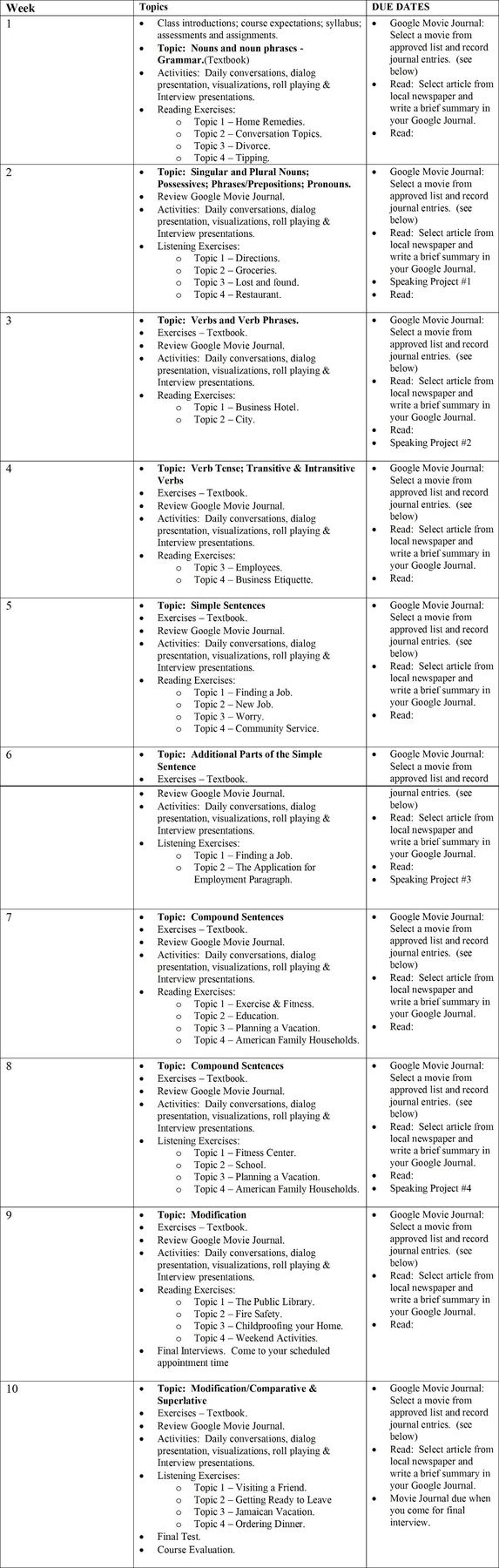
You will have a variety of speaking assignments including Daily Conversation Hosting, Dialogue Presentations, speeches, roll playing and Interview Presentations. Your instructor will be listening for pronunciation, vocabulary use, and other things that we learn in class during your presentation(s). You must prepare for these assignments before class. You may need to prepare with a partner, so arrange a time with your partner to meet and prepare over the phone, Skype or in person. Be prepared before coming to class.
Quizzes:
You will often have quizzes focusing on pronunciation, dialogues or concerning vocabulary. These will be at the beginning of class. If you are late, you may miss these quizzes, if you miss them, you will not be able to make them up.
Names of My colleagues in class: Contact these people if you’re absent and get your assignments.
Tentative Calendar: Use this guide to study ahead
Movie Listening Journal:
Write your journal in your electronic journal - Google Docs (to be discussed with instructor). Write one page about a different movie each class session. Watch the movie in English only. If you watch it with subtitles in your language it may hinder your listening practice. Watch the movie in English. Do not use the subtitles. Use this journal to practice LISTENING, not reading.
For short ESL movies go to: https://www.youtube.com/results?search_query=Short+esl+movies
You may watch the movie with some other classmates, but you must write your journal by yourself. If you would like to see a movie currently in the movie theater, you may, but you must get the movie approved by your instructor.
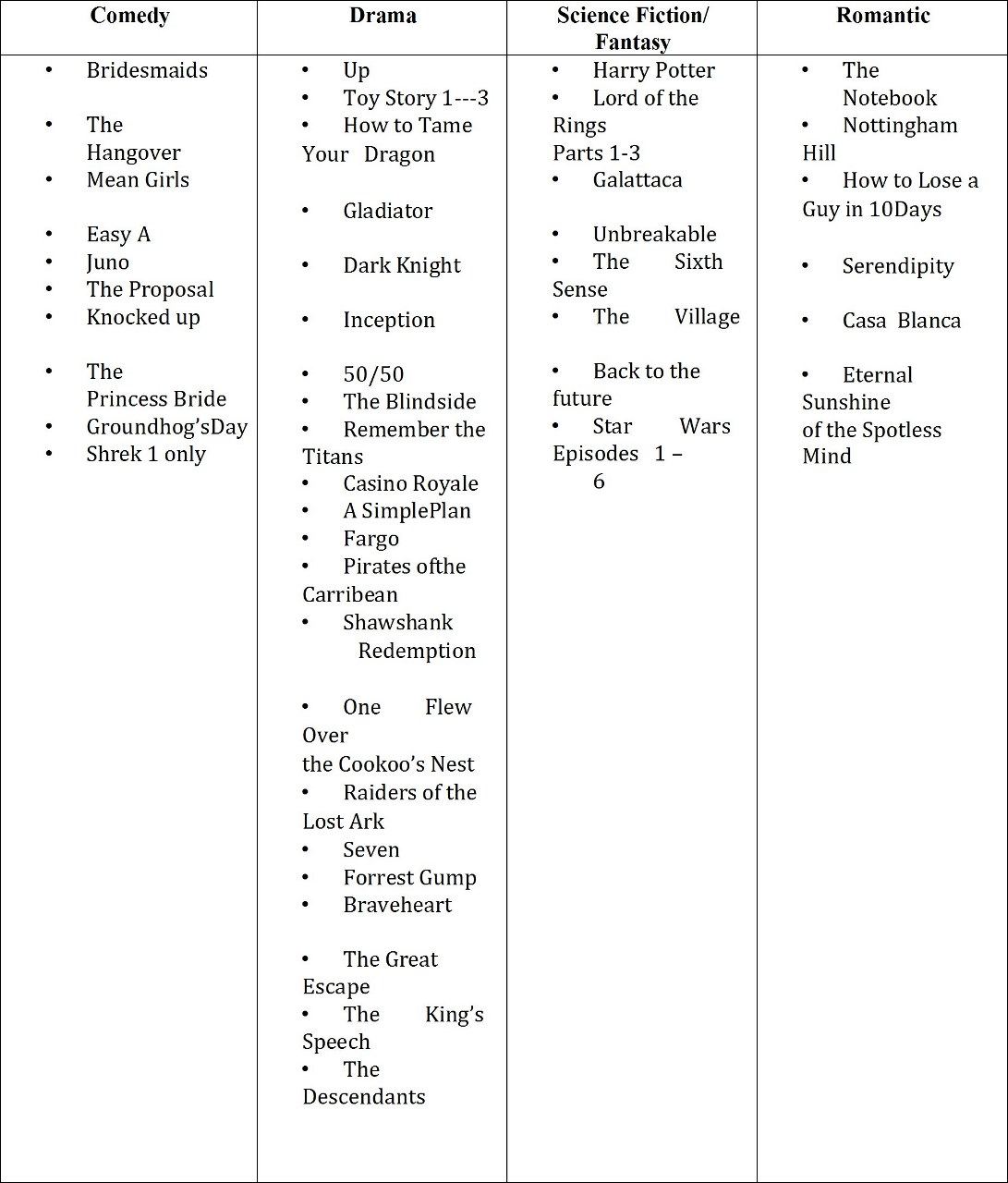
Movie Journal Assignment: Choose a Movie from the Approved Movie List on the next page.
The journal entry has two parts:
1. Vocabulary
While you’re watching the movie write down five words or phrases that you hear that are unfamiliar. Ask an American what those phrases mean and write the definitions on one page in your journal.
2. Response
Write a RESPONSE to the movie. A response is your feelings about the movie. Your response should be one page. Do not write a summary of the movie. If you do, points will be taken off your journal. Your response needs to be a full page. Do not skip lines. Use these questions to guide your response, but please write in paragraph form:
1. How did themoviemakeyouthinkdifferently?
2. Wasthemoviefunnytoyou? Explain.
3. Whichcharactersdidyouidentifywithinthemovie?
4. Whatdidyoudislikeaboutthemovie? Explain.
5. Wasanysituationinthemoviesimilartoreallifeinanyway? Explain.
6. Whatweresomethemesthatyounoticedinthe movie? What situationsinthemoviemadeyou notice thosethemes?
7. Whatisyouropinionofthemovie?
8. What was strange or different from your cultureinthemovie?
Approved Movie List: ONLY watch the movies on this list. You must ask your instructor for approval of other movies/videos.
ADW 1012 Waiter and Waitress
Course Description
Whether you are looking for a part-time job, a summer job, work to help you through college, to supplement your family income, or a possible career, working in the restaurant industry as a waitress can be your answer. This course will discuss all the necessary information for you to learn what the job is about, how to prepare for it, what you need to know, and whether or not you have the personality to do the job well.
Waiting tables is a time-honored tradition that started long ago in England and Europe, and came over to America and continues to this day. At one time, serving others for money used to be viewed as a lower-class line of work. Today there are people who make an excellent living waiting tables, pulling in nearly two thousand dollars a week.
Interviews with waiters, waitresses, hiring managers, and restaurant owners provide the information that you need to supply what they are looking for in a good waitress. Whether you wish to work in a family-style restaurant, or you want to work in a fine dining establishment, this course will guide you through the information you need to have in order to make a good decision about your work, and possibly whether or not you can improve your situation by waiting tables. In this course you will learn who you work with and why, what your job is in different restaurant settings, the various serving methods that have their origin in other countries, etc. You will also get some insight into serving alcohol, learning the requirements of your patrons and how best to serve them and their desires. Lastly, the course will reveal the very great need for safety and proper sanitation in order to avoid contaminating food that you will be serving to your customers. Waiting tables will turn you into a student of human nature. By the end of this course you will be prepared to apply at even the highest end restaurant.
Course Requirements
The course is open to everyone. There are no required books. All material will be given online and through netlinks. You'll need a high school reading level though.
Course Topics
Lesson Plan Outline
Lesson 1: So you want to be a Waitress?
A. Self-Assessment
1. Are you a people person?
2. Problem solving your forte?
3. Keeping cool under fire?
B. The job
C. The hours
D. The pay
E. The responsibilities
F. The payoff
Lesson 2: The Serving Staff
A. Hiring trends
B. Job Lists
C. Providing Great Service
D. What NOT to do in Service
Lesson 3: Types of Service and Table Settings
A. Types of Restaurants
B. Staff Positions and Duties
C. Hosting
D. Special Parties
Lesson 4: Table Service
A. Types of Service
B. Table side Service
C. Table settings
D. Breakfast
E. Lunch
F. Dinner
G. Elegant
Lesson 5: Taking Orders
A. Giving and Collecting Orders
1. Approaching the table
2. Prompt Attention to needs
3. Drink Orders
4. Explaining the Menu
B. Taking the Food Order
C. Delivering the Food
D. Checking Back
E. Dessert
F. Presenting the Check
G. Carrying Trays
Lesson 6: Suggestions and Suggestive selling
A. Making suggestions to the customer
B. Substitutions
C. Purpose of Suggestive Selling
D. Specials and higher priced items
E. Value-added service
Lesson 7: Special Situations
A. Customers with kids
1. Keeping kids occupied
2. Crackers and speedy service
3. Kids’ meals and menus
B. Multiple tables
C. Dealing with unhappy customers
D. When to get the manager involved.
Lesson 8: Other Duties
A. Side-Work Duties
1. Coffee Service
2. Bread Baskets
B. Menu knowledge
1. Cooking terms
2. Preparation methods
Lesson 9: Beverage Service
A. Alcohol
1. Alcohol Training
2. Alcohol Safety
B. How to Serve Alcohol
C. Bar Terms
D. Wine and Wine labels/Serving Wine
1. Tasting tips
2. Describing wine
E. Glassware
F. Taking Drink Orders
Lesson 10: Team Work
A. Bussing
B. Expediting
C. Responsibilities
D. Tipping-out
Lesson 11: Sanitation/Food Safety
A. Accidents
1. Strains
2. Falling/slipping
3. Choking
B. Hazardous Chemicals
C. Bacterial cross-contamination
1. Bacteriology 101
2. Dangerous forms
3. Controlling bacteria
D. Hygiene.
ADC 2056 Cooking and Baking
Course Description
Cooking and baking are the kinds of activities that most people assume are second nature. After all, we're humans, and our most basic need is to supply ourselves with nutrition. Logically, we should just be able to get in the kitchen and make something to eat.
Many people grow up watching their mothers or fathers cook; they may see them read recipes, combine ingredients, and use sauté pans. These same people often take for granted the ability to get into the kitchen and know what to do.
Having an inborn ability to cook isn't guaranteed. Studies show that having a good role model in the kitchen is one of the best ways to learn how to cook and bake. However, maybe you never had the opportunity to watch someone cook. Perhaps you never had enough time to really apply yourself to the task. Maybe you're just scared of not knowing what to do.
The good news is, it's never too late to start, no matter what your background may be. The most important thing to take with you into the kitchen is a basic understanding of what to do and how to do it.
This course is designed to give you just that. You will learn everything from what supplies you need for getting started to reading recipes and planning meals. You will be provided with a basic understanding of what it means to be in the kitchen and sources for additional information to foster a lifetime of culinary growth!
Course Requirements
No previous experience is required but you should know how to work around hot stove tops, and know how to use an oven. In addition, you'll need kitchen supplies--most you probably already own.
Course Topics
I. Cooking vs. Baking: A Brief Overview
a. What is Cooking?
b. What is Baking?
II. Kitchen Equipment
a. Common Cooking and Baking Appliances
b. Less Common Cooking and Baking Appliances
c. Cooking and Baking Utensils
III. Cooking Terms
a. Understanding Recipe Vocabulary
b. Basic Kitchen Terms
i. Ingredient Terms
ii. Action Terms
IV. Baking Terms
a. Understanding Baking Recipe Vocabulary
b. Basic Baking Terms
i. Food Terms
ii. Action Terms
V. Fresh Ingredients
a. Seasonal Produce
i. Spring Fruit
ii. Summer Fruit
iii. Fall Fruit
iv. Winter Fruit
v. Spring Vegetables
vi. Summer Vegetables
vii. Fall Vegetables
viii. Winter Vegetables
b. Fresh Herbs and Spices
VI. Pantry Essentials
a. Baking Essentials
b. Cooking Essentials
i. Canned Goods
ii. Fresh Items
iii. Dried Herbs and Spices
iv. Miscellaneous Items
c. Building a Pantry
d. Rotating Pantry Items
VII. Using Cooking Recipes
a. Reading a Cooking Recipe
b. Measuring for a Recipe
VIII. Using Baking Recipes
a. Reading a Baking Recipe
b. Baking-Specific Directions
IX. Expanding Recipes
a. Measuring Tools
b. Measurement Conversions
i. Dry Ingredient Conversions
ii. Wet Ingredient Conversions
c. Multiplying Recipes
d. Finding and Storing Recipes
X. Meal Planning
a. Cooking Small
b. Cooking Big
c. Using Leftovers
XI. Safety in the Kitchen
a. Dangerous Foods
b. Storing Food
c. Tips for Safe Food Handling
d. For More Information
e. Keeping Kids Safe
AA 2057 Specialization Protocols Elective
Course Description
Have you always had an interest and fascination with seeing the world? Do you enjoy traveling to and experiencing exotic places? Then this is the course for you! This course is specifically designed for Cruise Ship Workers and people that want to work in the hotel industry. This includes professional chefs, waiters/waitress, and other hospitality personnel within the hotel and cruise industry around the world.
This course prepares you to work in the global force! This course is designed to understand the cruise line industry as a unique tourism product. The class will focus on the history, diversity and sustainability of cruises, restuarants, hotels in the United States, as well as Canada and the Caribbean. Additionally, this course will be used as a field-base student experience that emphasizes a reciprocal relationship between the course content and the cruise and resturant community.
The possibility of working on a Cruise Line and the Career Paths it affords are numerous and exciting. Not to mention the various perks, exposure and places of travel that one will enjoy as a result of embarking on a career in the Cruise Ship or Hotel and Restuarnt Industry. Moreover, this course will assist one in diversifying their skills, talents and abilities.
Prerequisites: High school Diploma or
Prior Learning Experience (4 Years on the field)
Mature Adult Student
Completing your Associates in Tourism and Hospitality
COURSE OBJECTIVES
Examine cruise line history, products and career opportunities.
Explore the typical organizational structure of cruise lines and restuarants.
Identify the various protocols required for working on a cruise ship as a chef/waiter or the
hospitality industry itself.
Explain the various lifestyle changes that would have to be in order to adjust to life on a cruise
Ship.
Gain an appreciation of ship’s crew and their daily service or administrative roles.

Course Topics
I. CAREER PATH OF A CHEF
a. Job Opportunities on a Cruise Ship/Restaurants as a Chef
Some of the typical job opportunities on a cruise ship/restaurant might include the
following:
Executive Chef – Overseer of culinary operations and team, as well as presentations and preparation
Baker – Responsible for baking multiple daily bread presentations
Cook – All-purpose culinary work
Pastry chef – Preparation of a wide variety of pastries
Sushi chef – Preparation of sushi or other Asia-inspired cuisine
Party chef – Preparation of food for parties and special events
Pantry cook – In charge of food forecast and requisitions, budgeting, supervising staff, setting up cold displays at buffet stations
Sous chef – Second in command to the executive chef
Culinary administrator – Supervising staff, coordinating with the executive chef and other managers, overseeing budget, presentation, quality of food, and sanitation
b. Essential duties and responsibilities
Operational
Training & Development
Financial
Safety Responsibilities
Other Duties and Responsibilities (Other duties may be assigned.)
Qualifications
Required computer skills
Education/experience/certifications
Work Environment & Physical Demands
The vision requirements
Proper Hygiene
Proper Handwashing Procedures
Sanitation Inspections
c. HAACP Approach to Food Safety
II. SELLING/SERVICE OF WAITRESSING
Role of a Waiter/Waitress
Skills Required
Types of Communication Suited for the Service Industry
How to deal with difficult customers
Best Practices for Waitressing
Duties and Responsibilities of a Waiter
Health & Hygiene Protocols
Hours of Work/Physical Demands of the job
Billing & Payment Procedures
Training & Development of Staff
III. WHAT TO EXPECT WHEN JOINING A CRUISE LINE
• Requirements for Becoming a Crew Member
• Protocols for Embarking & Disembarking on a Ship
• Privileges & Perks as Crew Members
• Changes in Health & Safety Protocols post Pandemic
• Business Ethics
• STCW Basic Safety Training Certification
IV. ENVIRONMENT/SAFETY
• Cruises and the environment
• Role of port authority
• Security and security on-board
V. LIFE ON BOARD
• Living and working on a modern cruise ship
• How to get a job on a cruise ship
• Job descriptions of positions
Các chương trình Tiến sĩ (PhD) của chúng tôi mang đến cơ hội học tập nâng cao với sự linh hoạt khi hoàn thành các học phần trực tuyến trong một chương trình bậc tiến sĩ.